If you run an online store, you're probably familiar with the SEO treadmill. Keyword research eats up hours. Product descriptions pile up faster than you can optimize them. Rankings shift quietly, and traffic drops often show up before the reason does.
Search itself is changing at the same time. Google's AI Overviews now answer many questions before a shopper ever clicks through, and more product discovery is happening within tools like ChatGPT and Perplexity. For a small ecommerce business working with limited time and budget, keeping pace can feel like a stretch.
The encouraging part is that the same AI technology reshaping search can also take pressure off your SEO. Applied well, AI workflows collapse hours of manual effort into a fraction of the time and surface opportunities that are easy to overlook. Handle them carelessly, though, and the same tools will bury a site under generic content that does more harm than good.
This guide walks through practical AI-powered SEO workflows for ecommerce store owners, highlights where AI adds the most value, and shows where human judgment still carries the weight.
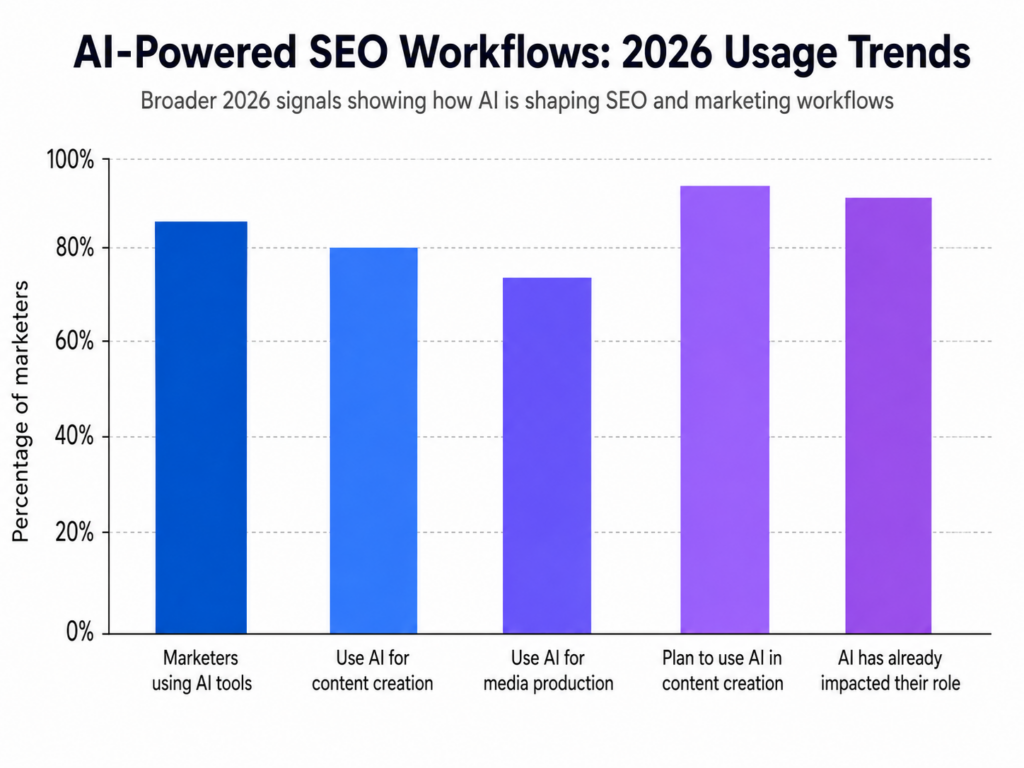
The data summarized in the graph above reflects how central AI has become to SEO and marketing workflows in 2026. In HubSpot's 2026 State of Marketing Report, more than 90 percent of marketers said they are already optimizing, or plan to optimize, for both traditional and AI-powered search, and over 80 percent reported using AI for content creation. Far fewer have a fully integrated AI search and SEO strategy in place, pointing to a gap between adopting the tools and building a repeatable process around them.
An AI-powered SEO workflow is a repeatable process in which AI tools handle the data-heavy, repetitive parts of search optimization. At the same time, people stay responsible for strategy and quality control.
Rather than guessing which keywords might rank, AI tools can study search behavior, user engagement, and content performance at a scale that is difficult to match manually. Industry analyses of AI-driven search optimization describe a shift away from chasing individual keywords and toward optimizing for intent, meaning what a shopper is actually trying to accomplish when they search.
In practice, that allows AI to help you:
The workflow piece is what matters. A single AI tool used at random tends to produce random results. A consistent process, run weekly or monthly, is what compounds into growth over time.
Traditional keyword research starts with a seed term and a spreadsheet. AI-assisted research usually starts with a different question: what problems are customers actually trying to solve?
A practical monthly workflow looks something like this:
This approach tends to improve lead and traffic quality because visitors land with intent that matches the page. The pattern is straightforward: a business that stops competing for one broad, difficult head term and instead builds content around the specific workflow problems its customers search for usually earns better-qualified traffic and stronger engagement over the following months.
The same reasoning applies to a store selling hiking gear, where "best waterproof boots for wide feet" often converts better than "hiking boots" even though it draws fewer searches.
For most store owners, content is the bottleneck. AI can speed things up, but mainly when it operates within clear guardrails. Left without direction, it leans toward generic output. Given the right prompts, brand guidelines, product details, and a review process, it becomes a practical way to produce better content faster without sacrificing quality or accuracy.
A workable content production workflow:
Where near-duplicate product pages cannot be avoided, a self-referencing canonical tag on each page paired with genuinely distinct copy on your best sellers usually does more good than trying to spin every variant.
Google's guidance has stayed consistent on this point: it judges content quality, not how you create it. Helpful, original, experience-backed pages tend to perform fine regardless of AI involvement. Thin, mass-generated pages tend not to, and at volume, they can drag down how the rest of the site is assessed.
Technical SEO is where automation delivers the clearest, lowest-risk wins. Most modern SEO platforms can crawl a site, catch broken links, flag missing metadata, identify duplicate content, monitor page speed issues, surface redirect problems, and report indexing errors. That helps you spot issues sooner, prioritize fixes, and keep the site healthier without relying on manual checks alone.
A monthly or weekly automation setup typically covers:
The workflow is straightforward in principle: review the flagged issues, fix the ones affecting indexable, revenue-driving pages first, and set aside the low-priority noise. For ecommerce sites running hundreds or thousands of SKUs, this alone can save several hours a month.
A few of the issues these audits raise are worth understanding in more detail, because the fix is rarely as simple as deleting something:
One practical caution: do not blindly fix everything a crawler reports. Audit tools generate false positives, including pages you intentionally set to noindex, paginated series, and staging URLs that slipped into a report. Skim for those before you start "fixing" things, or you can lose a morning solving problems that never existed.
This is the newest piece, and for ecommerce it is getting harder to ignore. Shoppers increasingly ask AI assistants for product recommendations, and those answers draw on sources the assistants consider trustworthy.
A growing set of tools, including SE Ranking's AI Search Toolkit and similar trackers, now monitor whether your brand appears in AI Overviews, ChatGPT, Perplexity, and Gemini responses for relevant queries.
A basic monthly workflow:
The principles that earn AI citations overlap heavily with traditional SEO fundamentals: clear structure, direct answers to specific questions, demonstrated expertise, and accurate product data. Structured data markup on product pages also helps, since it gives AI systems clean information to work from.
In practice, that usually means valid Product, Offer, and AggregateRating schema in JSON-LD, with price, availability, and review data that actually matches what is on the page. Mismatched or stale markup can do more harm than good, so it is worth validating after any template change.
AI tools can analyze historical search data and emerging trends to forecast shifts in seasonal e-commerce demand that could reshape the planning calendar.
The payoff here is timing. A retailer that catches an early signal, say, rising interest in eco-friendly packaging, and publishes optimized content before demand peaks can hold strong positions once search volume surges.
The workflow behind that kind of result is repeatable:
This moves SEO from reactive to proactive, which is often where smaller stores can outmaneuver slower competitors.
AI handles scale. It does not handle taste, accuracy, or accountability. People need to stay in charge of strategy, brand voice, fact-checking, customer insight, and final decisions. Automation can speed up the work, but human judgment usually keeps it useful, trustworthy, and aligned with the business.
The strongest results tend to come when AI supports the team rather than replacing it.
A useful rule of thumb: automate the analysis, accelerate the drafting, and own the decisions.
The right AI SEO tools make ecommerce optimization easier to manage, especially for stores with many product and category pages and ongoing technical updates. The platforms below can support keyword research, content drafting, metadata optimization, technical audits, structured data, rank tracking, and AI search visibility. The point is not to replace human strategy, but to give store owners a faster, more organized way to work on SEO while maintaining quality control.
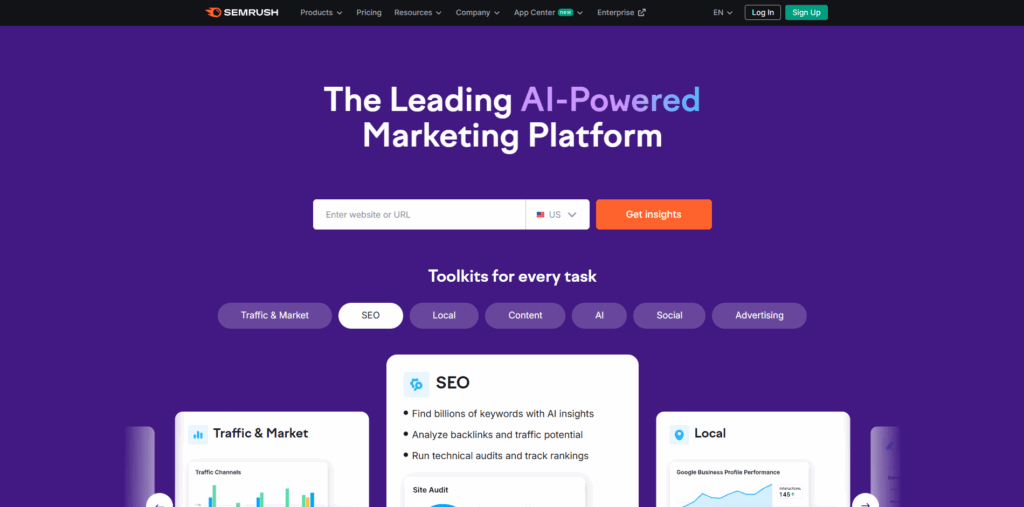
Semrush is a comprehensive SEO platform that supports ecommerce teams with keyword research, competitor analysis, site audits, content planning, and AI-driven visibility tracking. On lower tiers, monitor the Site Audit crawl limit so large catalogs aren't only partially crawled.
Features:
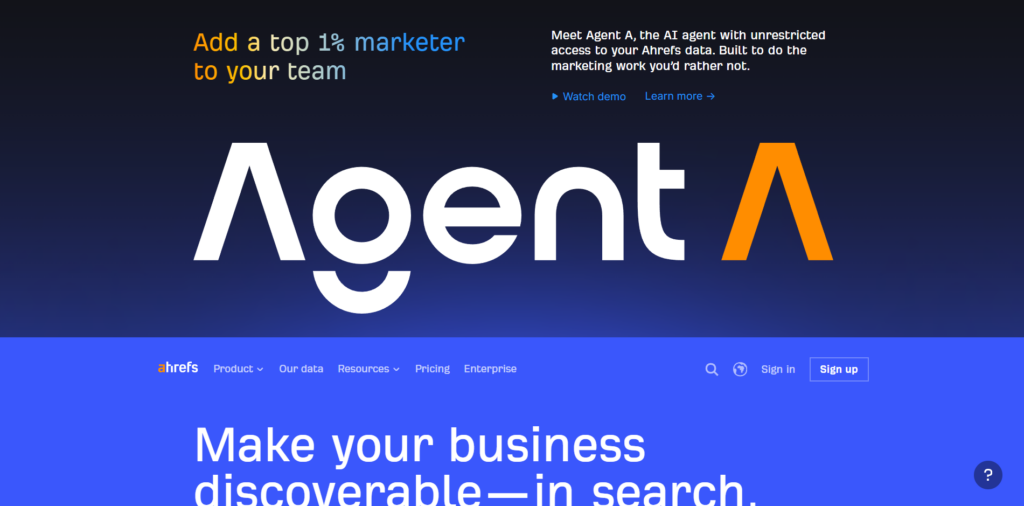
Ahrefs can be a good fit for ecommerce stores that lean on content, backlinks, and competitor research. For headless or JS-heavy storefronts, enable JS rendering in Site Audit so it doesn't flag client-side content as missing.
Features:

SE Ranking is an all-in-one SEO platform that often works well for small and mid-sized ecommerce stores. Rank-tracking cost is tied to check frequency, so you can scale down daily checks for lower-priority keywords.
Features:

Surfer SEO helps ecommerce teams shape content around search data, especially category pages, buying guides, and comparison articles. Treat the content score as a guide, not a target to max out, or category copy reads awkwardly.
Features:
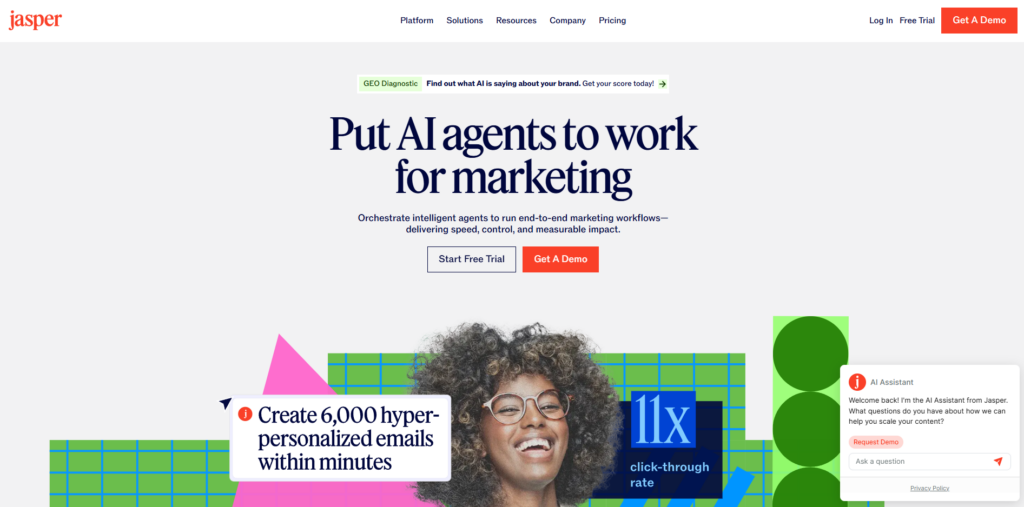
Jasper is an AI writing platform that can help draft product descriptions, ad copy, and category content. Feed in real product attributes for each item to avoid near-duplicate copy across similar SKUs, and fact-check the generated specs.
Features:
Google has said it evaluates content based on quality and helpfulness, not on how it was produced. AI-assisted content that is accurate, original, and genuinely useful typically performs fine. Problems usually surface when stores publish unedited, mass-generated pages with no real expertise or differentiation. The safer route is to use AI for drafting and research while keeping human review and editing in the loop.
Pricing varies widely and changes often, so check current plans before budgeting. As of 2026, entry tiers on the major all-in-one platforms generally sit around 100 to 140 dollars per month; for example, Semrush Pro, Ahrefs Lite, and SE Ranking Core, while lighter or standalone tools can run under 40 dollars per month. Many platforms offer free trials, so you can test features against an existing workflow before committing. For most small stores, one well-chosen platform can cover auditing, rank tracking, and keyword research without needing a full stack.
SEO timelines haven't changed much just because AI is involved. Technical fixes can show impact within weeks, while new content and topic clusters often take 2 to 4 months to build rankings, depending on competition. AI mainly compresses the production side, allowing you to do more in the same amount of time. It is reasonable to treat the first quarter as a baseline period and measure from there.
Yes. AI assistants and AI Overviews tend to pull from content that already ranks well and demonstrates expertise, so traditional SEO fundamentals remain the foundation. Clear site structure, fast pages, accurate product data, and helpful content support visibility in both traditional search results and AI-generated answers. Think of AI search optimization as an extension of SEO, not a replacement.
Not reliably. AI handles repetitive analysis, drafting, and monitoring well. Still, it cannot verify product facts, hold a consistent brand voice, or make strategic calls about which products and markets to prioritize. Stores that get the best results typically use AI to speed up execution while keeping a person responsible for quality and direction.
You don't need a full tool stack on day one. A realistic starting point for a small ecommerce business is simple: one AI writing tool, one SEO platform, one analytics dashboard, and one automation workflow. Start with the areas that save the most time and prove their value, then expand only once the process works.
Results vary by site, competition, and consistency, so treat the first quarter as a baseline-building period rather than expecting immediate jumps.
These workflows are built to run in-house, and most small teams can adopt them gradually. For store owners who would rather get a second set of eyes on their current setup, a structured SEO audit can help pinpoint which workflow is worth starting with for their specific situation. Either way, the stores that get the most out of AI in SEO pair the tools with a consistent, deliberate process rather than chasing every new feature.
"*" indicates required fields
"*" indicates required fields
"*" indicates required fields